Friday, June 14, 2013

Friday Facts – Llamas!


It's Chili!
Happy Friday! Today we bring you llama facts!  Llamas? But they’re not primates?  At the sanctuary, we have other residents, including Minnie the donkey, Whisky and Seek the horses and Chili the llama.  Chili is a fun-loving llama.  He happily runs down the pasture and enjoys play-dates with his doggie friend Bosley.  When Bosley was a puppy, they would romp and play for hours in the grass.  They still look forward to their time together.  Chili is curious, especially when we are unloading groceries from the car. One day, one of the volunteers left her trunk open while unloading and Chili took it as a buffet, standing behind the car and eating the fresh veggies right out of the trunk!  He spends time near Pockets, and when I am giving the monkeys bananas outside, Chili always gets the peels, so everyone has a share.

Did you know?
·         Llamas are members of the camelid, or camel, family and are related to alpacas, guanacos and vicuñas

·         They are hearty animals, living high in the Andes Mountain in rough terrain where indigenous peoples have used them as pack animals for hundreds of years.  People also use their wool as it is very soft and lanolin free. 

·         People also use llamas to guard livestock from predators

·         An adult llama can weigh up to 250 pounds.  A baby llama is called a cria and weighs between 20 to 30 pounds. 

·         Gestation is around 350 days – almost one year!  At the time of birth all the female or Dams of the herd gather around to protect the birthing mother and her cria.  Birth is usually quick and problem-free, over in less than 30 minutes and done while standing.

·         Llamas are herbivores who graze on grass and, like cows, regurgitate their food and chew it as cud. They chomp on wads for some time before swallowing them for complete digestion. Llamas can survive by eating many different kinds of plants and they need little water.

·         If a llama get annoyed, they pull back their ears and spit.  Chili is a happy sweet guy, so that has never happened!

·         Llamas are social animals and prefer to live with other llamas or herd animals.  Chili enjoys being part of the SBFPS herd along with Minnie and Whisky.  He is still working out his relationship with Seek, as she is the new girl on the block.

Friday, April 26, 2013

Friday Facts - Spider Monkeys!


It's George!
On this beautiful spring-like Friday we bring you Spider Monkey facts!  George is a very vocal black spider monkey who loves to tell you all about his day.  After the cleaning is done, I look forward to one-on-one time with George, playing, grooming and “talking” with him.  He is particularly taken by blondes and will show is masculine side preening for the girls.  He is an elderly gentleman in his 40’s, although you would never know it by the way he swings around inside and outside! His favourite treats are dates, and peanut butter and banana sandwiches.   

Mr. Jenkins is a black-handed spider monkey who loves to play. His area is full of swings, tents, blankets, food puzzles and toys.  He LOVES celery chewing it, spreading the juice all over his chest while making happy sounds!  If Chili the llama comes too close for his liking while he is outdoors, Jenks will break into loud barking to protest.
Jenkins playing with a treat box
 

·        Spider monkeys are of the genus Ateles which contains seven species, such as Red-faced, White-fronted, and Colombian.  Sadly, Black-headed and Brown spider monkeys are listed as Endangered (EN) on the IUCN Red List.

·        Spider monkeys are “New World” monkeys found in Central America in the countries of Mexico, Belize, Costa Rica, El Salvador, Guatemala, Honduras, Nicaragua and Panama.

·        Spider monkeys live in the canopy (arboreal), are active during the day (diurnal) and have a long prehensile (gripping) tail, sometimes called the fifth limb.

·        Spider monkey communities are “fission-fusion”, meaning that they split up into smaller subgroups to forage and sleep and then come together again.

·         Their diet includes fruit, leaves, flowers, nuts, seeds, insects, arachnids and eggs.

·        In the spider monkey world, the females choose their mates and will have a single baby every two to five years. The babies depend completely on their mothers for about ten weeks.  After that, the young ones will integrate into the troop, moving on their mother’s back for a year, and being dependent on their moms for three years.

·         A highly vocal primate, their vocabulary consists of barks, screeches, whinnying and howling.  You can always hear George and his neighbour Mr. Jenkins!

·        Spider monkeys are considered the most intelligent of the New World monkeys due to their brain size.  Jenkins and George are very clever and curious.

·         You can become a Foster Friend to George and Jenkins by visiting our website!
Jenkins and Pockets chatting outside
 

Friday, April 12, 2013

Friday Facts - Baboons!

Today, we share baboon facts!  Sweet Pea and Pierre are Olive baboons and Nan is a Hamadryas baboon.  While in Kenya, it was special to see wild baboon troops on the Maasai Mara. Sadly their numbers are dwindling due to habitat loss, poaching for bush meat and the illegal pet trade.  Sweet Pea is very maternal and loves to groom for hours.  


Sweet Pea enjoys a nap on a giant stuffy!
Pea especially likes large stuffed animals and faux fur to play with and sleep on, as you can see in the photo. She also likes puzzles, taking things apart and putting them back together again.  Pierre is a handsome male who is highly social and supportive towards Sweet Pea and his neighbours.  They enjoy special treats like sugar cane and foraging in the straw for raisins and berries and their pools in the summertime.  Nan or “Nannie” as she is affectionately known, loves her lettuce and enjoys being outside and basking in the sun.  At this time of year, a special treat for all the monkeys is the tender shoots of dogwood which we clip and put in their enclosures.  Nan even put her lettuce aside this past Saturday to chew on the red branches!


Statue of the god Toth
·          Ancient Egyptians considered the baboon to be sacred and related them with the god Thoth. The Egyptians believed him to be the inventor of spoken and written language, astronomy, geometry, and medicine. 
(Photo: Museum of Antiquities)


·          There are five species of baboons:  Chacma, Olive, Yellow, Guinea and Hamadryas.

·          Baboons are “Old World” monkeys who live in arid and semi-arid conditions like the Savannah. Hamadryas baboon live in cliffs, so Nan has many platforms and walkways.

·      They are ground dwellers and do not have prehensile tails.  Pockets, a capuchin, is a “New World” monkey with a long prehensile (gripping) tail that helps him climb (and paint!)

·       Baboons are omnivores and will eat plants, insects and small animals. Sweet Pea particularly looks forward to raw or boiled eggs!

The "divine" Nan
·          Baboons have a complex social structure made of dominant males and females from the same families.  It is observed and carried from one generation to the next.

·      The baboon’s gestation period is six months and they typically have a single offspring.  If it is female, it will have a lasting bond with the mother and will remain in the same troop all of their lives.  If it is a male, upon sexual maturity at six years of age, he will leave the troop to create his own troop or join another.

·       Baboons have large canine teeth and will “yawn” to display them passively.

·          Some of their vocalizations include grunting, screaming and barking as they call to their troop members to warn or to get a sense of where they are.  At night, they will long-call.  There are ten different documented sounds.

·          You can become a Foster Friend to Sweet Pea, Pierre and Nan by visiting our website! Foster by April 20 and get a bonus monkey handprint to go with!

Pierre enjoying sugar cane

Friday, March 22, 2013

Friday Facts - Capuchins!


Pockets being reflective
 
Pockets is a White Headed Capuchin and Cheeko is a Tufted or Black Capped Capuchin.  Did you know that capuchins are considered the most intelligent of the New World monkeys and that they are sophisticated tool users?  We can attest to that!  Therefore, they need a high level of enrichment activities – games, puzzles, plants, tree branches, structures and food devices.  Pockets is always being inventive and finding new ways to do things!  As you know, he loves to paint and gets so excited to use different colours and techniques when creating.  Cheeko is very curious and checks out all the new things, plays with the “monkey in the mirror” and basks in the glow of his heat lamp.  The two boys play and tease each other with their long prehensile tails.  Although from South America, they enjoying going out and playing in the snow too, albeit for short spurts of time.  It is important that they have the choice to do so.
Cheeko enjoys the foliage
·        Capuchins have the largest brains of all the New World monkeys.
·        Like other monkeys in the genus Cebus, the White Headed Capuchin is named after the friars of the Order of Friars Minor Capuchin– the cowls worn by these friars closely resemble the monkey's head coloration. When explorers in the 15th century found small monkeys which looked like these friars, they named them capuchin monkeys.
·        They can be between eight to thirteen pounds, with females being smaller.  Their life span is between 30 to 45 years.
·        It takes approximate two years for a young capuchin monkey to become independent from its mother.
·        Capuchins are active in the daytime, and live in groups of 3-30, including at least one male.
·        Capuchins are very vocal animals that scream, whistle and bark. Pockets and Cheeko are always chatting and playing!  In this way, they call each other in order to maintain contact and may express their dislike if someone or something disturbs them.  As with most primates, they frequently groom each other and have complex social lives with alliances made between different individuals.
·        Capuchins are tree dwellers who live in low-lying forests, in primary or advanced rainforests. They are native to Southern Central America and are found from Costa Rica to Paraguay and Trinidad. When I was volunteering in Costa Rica, the forests around us where home to wild troops.
·       Tufted capuchins are more powerfully built than the other capuchins, with rougher fur and a short, thick tail. They have a bundle of long, hardened hair on the forehead that is pronounced or tufted.

Tuesday, December 25, 2012

Happy Holidays

Happy Holidays to all our SBFPS friends! May you enjoy this time with your families, friends and loved ones.  Thank you so much for your continued support. 

Tuesday, December 11, 2012

Press Release Story Book Farm Primate Sanctuary Welcomes Darwin

For immediate release
December 11, 2012

Story Book Farm Primate Sanctuary welcomes Darwin

Darwin, dubbed the “Ikea Monkey” by media and social media has made front page headlines around the world. On December 9, 2012 this infant macaque was found wandering in a retail parking lot.  Working together with other organizations, including Toronto Animal Services and Animal Alliance, Darwin is now a resident of Story Book Farm Primate Sanctuary (SBFPS) in Sunderland, Ontario.  “Darwin’s story highlights the issue of exotic animals as pets” states Sherri Delaney, founder of the sanctuary. He arrived at the sanctuary and is settling in where he will be socialized with other monkeys and be provided the type of care he requires including environmental and social enrichment. 

SBFPS is home to twenty-three (23) other primates who have come from private owners, roadside zoos and research.  “People do not realize that monkeys do not make good pets. When they pass infancy and mature, problems arise.  Social isolation and the need to be with their own kind results in aggression and stress behaviours. Raising them as humans is detrimental to their development, mental and social well being.” says Delaney. All infants need to be with their natural mothers to feed, learn social skills and to be loved – macaques in particular grow up in groups of infants surrounding their mother. Darwin was removed from his biological mother to become a pet, a pseudo-human child. Infant monkeys fetch high prices, fueling the black market trade – we are determined to find out who sold Darwin and where these monkeys are coming from. Breeder female primates are often exploited in the exotic pet trade and are left without their offspring, in terrible health and grieving as mothers do. While images of Darwin in a coat and diapers appear to indicate that he is well cared for, albeit highly unnatural, even with the best intentions owners are not equipped to handle a mature monkey with large canines who will demonstrate natural aggressive behaviours and tendencies. We are frequently contacted by owners who can no longer handle their “pet” monkey and need to relinquish them for safety purposes – this could have been Darwin in a few years if he hadn’t escaped.

Macaques are volatile in nature and carry the Herpes B virus, Hepatitis and many other transmissible diseases to humans, some of which can be fatal.  Owning a macaque has the potential to put the owners and community at risk to infection and injury. There could have been a very different outcome to this story if an injury had occurred. Recent incidents in Canada and US have resulted in death to both human owners and animals in their care. Currently, in Canada, no Federal or Provincial regulations exist around the ownership of exotic animals.  Municipalities are left to determine which animals are considered illegal and on what grounds. It is illegal for Toronto residents to own non-human primates, and so Darwin will not be returning to his previous owner, Yasmin Nakhuda. However, once the media buzz dies down, we are willing to work with her to ensure that she is confident that Darwin will be in good hands with all his mental, social and physical needs met. We want what is best for all parties involved, and we are happy to accommodate requests that are in Darwin’s best interests.

Darwin will now live life in sanctuary care, learning to be a monkey. He is adjusting well already, and is extremely confident for such a little monkey. He has been exploring his enclosure, playing with all his toys and interacting with the other monkeys in surrounding enclosures. Our hope is that he can be adopted by one of our baboons with a maternal instinct, since he is in need of a mother figure in his life and she is in need of social companionship. We encourage members of the public to visit Darwin’s Facebook (www.facebook.com/ikeamonkeydarwin) or sign up for our E-Newsletter to receive updates.

Donations for his care can be made at www.storybookfarmprimatesanctuary.com. As this is an unexpected arrival, we greatly appreciate any contributions – they will go a long way to securing the future of our residents.

About Story Book Farm Primate Sanctuary

Story Book Farm Primate Sanctuary is a sanctuary for primates who come from a variety of different backgrounds.  The farm is located approximately one hour north east of Toronto in the Sunderland area. Currently, we are home to 23 primates. We at SBFPS are committed to educating and raising awareness about the plight of captive primates, advocate on behalf of primates who do not have a voice of their own and help prevent cruelty to animals through the operation of a primate sanctuary.

Story Book Farm Primate Sanctuary is a place of safety. We offer freedom from fear. We are a place of healing and recovery from trauma. In sanctuary care, we encourage friendships between residents. We encourage exploration and freedom of choice. We give back the ability to make decisions and control events that affect residents' lives. Our human caregivers exercise deep listening skills to help address the residents' wants and needs. We strive for humility and parity and look at each day as a learning opportunity.  Our dedicated volunteers have extensive expertise in the care and husbandry of primates, including great apes.

Friday, December 7, 2012

Friday Facts – Meet the Browns (Lemurs that is!)


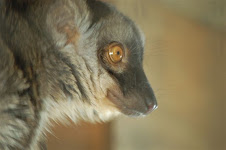
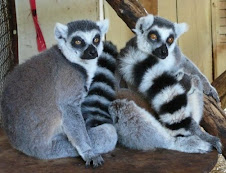
Rosie and Komoto are the two brown lemur residents at SBFPS. As primates, they are highly social, in the wild living in groups with up to 30 - 40 individuals.  In the sanctuary, they snuggle with each other and interact with their ring-tailed lemur neighbours.  “The Browns” as we call them are interested in watching the humans washing dishes and working around the barn.  One of their favourite treats are grapes – they are so cute when they eat them!  They have soft hands, are gentle and love to bask in the sun.  They are flight animals, meaning they would rather flee than fight.

Rosie enjoying a grape in her enrichment!
 
·        Lemurs are found on the island of Madagascar, located off the southeastern coast of Africa in the Indian Ocean. They have also been found to live on Mayotte, an island to the north of Madagascar.

·        Brown lemurs (Eulemur fulvus fulvus) are typically herbivores, eating fruits, flowers, and leaves, but they will, on occasion, eat centipedes, millipedes, and other insects. They will also consume bark, sap, and clay.

·        They live in forests, both rain forests and dry forests, ensures that they have an ample supply of food, with plenty of plant and animal life around to nibble on.

·         They are excellent jumpers, moving from tree to tree with ease and use their tail for balance when needed. They spend less than 2% of their time on the ground. When on the ground, they usually run around on all 4 legs.

·        As with all of the true lemurs, olfactory communication is extraordinarily important.  They have scent glands on their wrists and throats and use them to mark location and as an individual “signature”. 

·        The brown lemur is classified as near threatened on the IUCN (International Union of Conservation of Nature and Natural Resources) red list of threatened species. Over the past 3 generations (24 years) the population is estimated to have decreased by 20 to 25%. This is mostly due to decline in both the area and the quality of its habitat in its only known range. The brown lemur also suffers from exploration.
VOCAL COMMUNICATION
·        ohn: this is a nasal sound that is used in maintain-ing group cohesion (we hear this all the time in the barn!)
·        cree: this high-pitched sound is used as a terri-torial call
·        crou: this sound is the alarm call of the brown lemur